If something is burning, sparking or smoking
Switch the main breaker off if you can reach it safely, and call 911 if there is any sign of fire. Do not open panels or devices yourself. Everything below assumes the immediate danger is dealt with.
How a fault is found
The order matters. Measuring before opening anything keeps the search short.
Define the symptom
Which breaker, which rooms, what was running, how often, since when. Intermittent faults get a pattern written down before any testing.
Measure at the panel
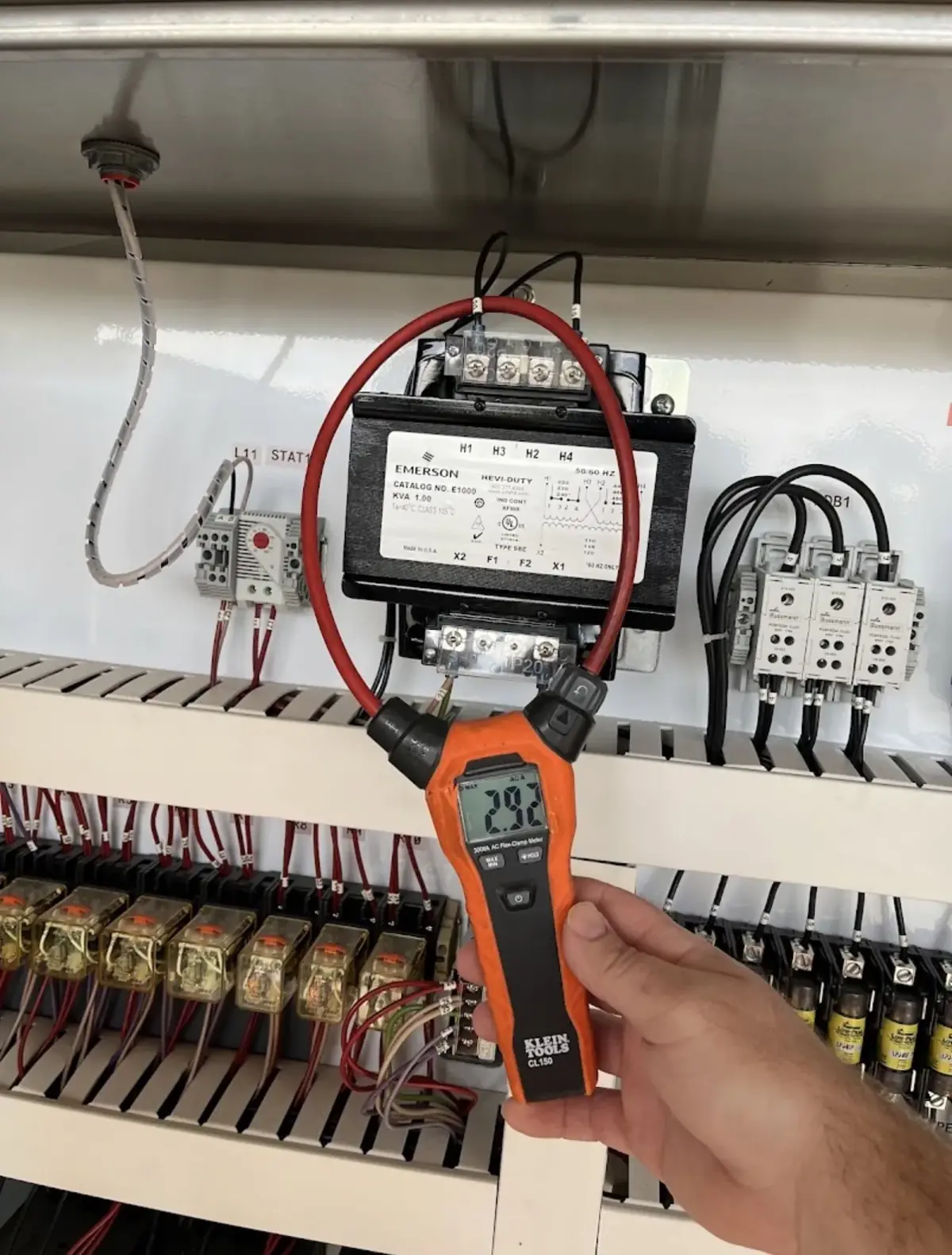
Voltage on each leg, current on the suspect circuit under load with a clamp meter, and a look at the breaker and its terminations. A breaker that trips below its rating is itself a finding.
Divide the circuit
Devices are disconnected in sequence until the fault clears. That points to a device, a cable run or a junction box. Insulation and continuity tests confirm it.
Repair and re-test
The faulty device, connection or cable section is replaced, then the circuit is loaded again and re-measured. The fix has to show in the readings.
Common problems and their usual causes
Breaker trips repeatedly
Overload on a single circuit is the most common cause in kitchens and bedrooms used as offices. Short circuits trip instantly, often from a damaged cord or a failed device. AFCI breakers trip on arcing from loose connections, and sometimes on older motors or vacuum cleaners. Worn breakers trip low or feel loose. Each has a different repair.
Outlet is dead, breaker is on
Check GFCI outlets in bathrooms, kitchen, garage and outside; one of them may protect the dead outlet. Otherwise it is usually a loose or burnt connection in a box upstream, commonly a backstabbed wire. That connection is a heat source and should be repaired, not bypassed.
Lights flicker or dim
One fixture on a dimmer: usually a dimmer and LED mismatch. Several rooms at once, especially when a large appliance starts: look at the panel and service connections, including a loose neutral, which needs attention promptly.
Outlet or switch is warm
Heat at a device means resistance at a connection or a device carrying more than it should. It is not normal and it is the stage before discolouration and failure. Stop using it until it is checked.
Partial power loss
Half the house out, or 240 V appliances misbehaving, points to one leg of the service being lost. That can be in the panel, the meter or at the utility connection. It is diagnosed at the panel first, and Toronto Hydro is involved if the problem is on their side.
What helps before we arrive
- Leave a tripping breaker off and leave it alone; repeated resets make the fault harder to find and can damage the breaker.
- Note what was plugged in and running when it happened, and the time of day.
- If an outlet is dead, note whether anything else stopped at the same time.
- Clear access to the panel: by code there should be about a metre of clear space in front of it.
- Do not open the panel cover or any device. Measurements inside are our job.